



How to invest in gold?
Gold is a tangible asset that has endured across centuries, crises and wars. It is the store of value par excellence. But not only that: gold is one of the ways to diversify your wealth. Sometimes seen as a slightly old-fashioned holding, could the precious metal in fact be a thoroughly contemporary investment? How do you buy investment-grade gold? What are the different investment strategies? Here are some answers.
Gold: an asset unlike any other
A precious metal with unique properties
Gold has exceptional physical and chemical characteristics: it neither oxidises nor corrodes. It is malleable and ductile — a single gram can be drawn into several metres of gold thread! These properties explain why it is as prized in jewellery as it is in certain high-tech industries. Even your mobile phone contains a few milligrams of gold!
Gold is becoming scarcer, and harder to extract
In 2025, global supply stood at around 5,000 tonnes of gold according to the World Gold Council, of which 3,671 tonnes came from mining. Since 2015, mined output has held between 3,580 and 3,670 tonnes a year. But specialists agree on one principle: gold is increasingly difficult to access, so extraction costs keep rising. An estimated 57,000 tonnes of the precious metal remain extractable, according to the American agency US Geological Survey.
Good to know: around 187,000 tonnes of gold have already been extracted, according to the US Geological Survey. For the World Gold Council, the figure is even higher: 217,000 tonnes (2024 data).
Recycling is not to be overlooked either, as it accounted for 28% of total world supply in 2025 (World Gold Council). The precious metal can be melted and re-melted, with no loss or degradation. This feeds alternatives such as transmutation (turning jewellery into investment gold). But here too, stocks are limited to gold that already exists.
Gold’s limited quantity and costly extraction make it a genuinely rare asset. For even though alchemists long sought the secret of making gold, no one has ever found how to produce bars or coins at will!
A historic store of value
From the first gold coins struck nearly 5,000 years ago to the investment coins still minted today, gold has always kept its status as a benchmark of value. The precious metal long served as the basis for successive monetary systems. Even in recent history: as little as 50 years ago, the dollar was still convertible into gold (Bretton Woods Agreement).
Central banks treat physical gold as a strategic asset. Many states regularly build up their reserves to diversify their holdings, reduce their dependence on certain currencies (the dollar in particular) or to hold a universally recognised asset.
Investing in gold: what to know before you start
The characteristics of gold as an investment
Physical gold is a safe haven, a store of value
The precious metal is often described as a safe haven. The subprime crisis (2008), the euro crisis (2011), more recently Covid-19, but also the war in Ukraine and the return of inflation have all confirmed this status. It was seen again throughout 2025, when the gold price set records against a backdrop of geopolitical uncertainty!
Some experts speak of a counter-cyclical asset: when every other form of investment (equities, property, commodities) falters, gold holds firm.
No yield, but a way to protect your wealth
The other defining feature of investing in gold is its lack of yield. Gold pays no dividend, no rent, generates no interest.
For many gold investors, owning the precious metal is above all a way to protect their wealth.
How does the gold price move?
How is the gold price set?
Since the end of the Bretton Woods Agreement, gold is no longer pegged to the dollar and its price moves freely. The price of gold at any given moment is set by international trading across various exchanges. You can follow the gold price in several ways:
- The LBMA fixing: the official reference price of the world’s gold professionals. Managed by the LBMA (London Bullion Market Association), it provides a benchmark gold price twice a day.
- The spot price: it tracks the buying and selling of “paper” gold, i.e. gold contracts (or gold ETFs). It also reflects the commodities markets. This is the price quoted on financial websites.
- The Veracash premium price: as with parent company AuCOFFRE, this adds to the LBMA fixing an analysis of the transactions (sales of tokens, coins, bars) between members of the platform.
Good to know: The gold price is usually quoted per troy ounce, i.e. 31.103 grams of pure gold. It can be expressed in euros or in dollars.
How has the gold price changed over 20 years?
Over the past two decades, the gold price has followed a long-term upward trend. Between 2000 and 2020 it rose by almost 400%, driven by a succession of financial, health and geopolitical crises. In March 2024, the price of an ounce in dollars passed the US$2,000 mark (US$2,180).
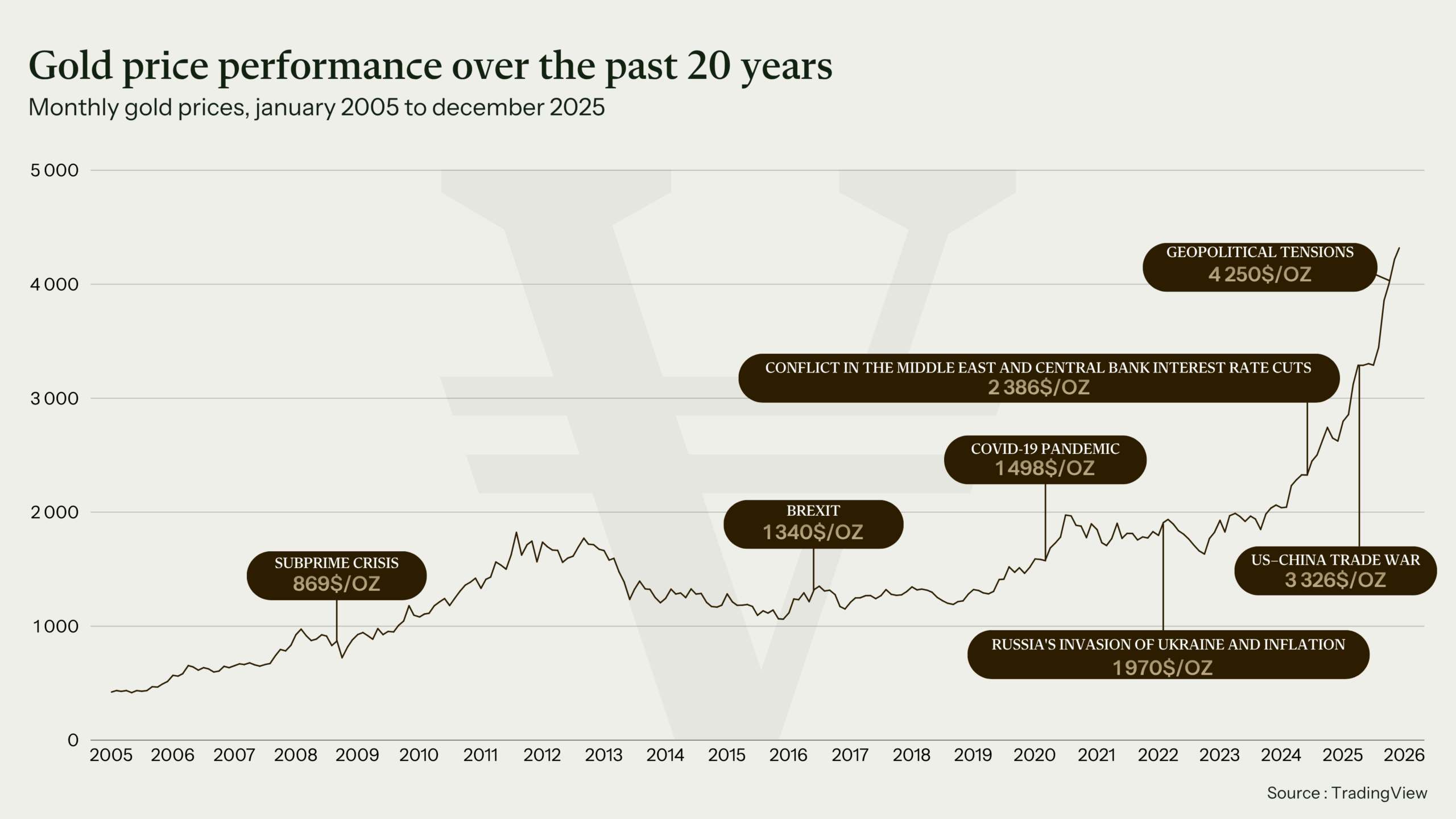
Why did the gold price set records in 2025?
The year 2025 was marked by a steady rise in prices, in dollars as in euros. By the end of December 2025, an ounce of gold reached US$4,539. Several factors explain this growth: the geopolitical context, of course, but also central-bank buying, the weakening of the dollar and falling interest rates (European Central Bank and US Federal Reserve).
2026 outlook: what trend for the gold price after the records?
After the historic highs of 2025, 2026 opens under the sign of consolidation for the safe-haven asset. As the price of an ounce settles durably above new technical levels, investors are watching closely for persistent inflation and tensions over sovereign debt.
In what form can you invest in gold?
If you visit your high-street bank, your adviser is unlikely to find you gold bars or coins to buy. At best, they will offer mining shares or gold futures (gold ETFs): paper gold. But the latter is directly exposed to the stock markets… which defeats the purpose if the goal is a counter-cyclical asset! Physical gold or paper gold, here are the main ways to invest in gold.
Investment gold as coins or bars
Gold coins and physical gold: how to buy investment gold?
There are several ways to buy investment gold coins or bars.
- Professional dealers’ shops (make sure they are professionals). This requires some knowledge, particularly in assessing the quality of coins so as not to overpay for a damaged coin or one with no premium (no cultural interest, no rarity, etc.).
- Peer-to-peer platforms online. These large marketplaces where individuals offer gold coins are well known. But beware! A photo cannot establish a coin’s quality.
- Professional platforms. AuCOFFRE.com, for example — a company with a well-established reputation and, above all, independent audits of its vault contents. Always favour a specialist that demonstrates transparency!
Paper gold: ETFs and mining shares
When specialists refer to “paper” gold, they mean certificates and gold ETFs (Exchange Traded Funds). Each certificate represents a weight of gold. In theory, it would be possible to redeem this gold physically.
Since holders of paper gold very rarely request conversion into physical gold, it is just as rare for that gold to be fully backed. Holders of gold contracts resell them without converting them into physical gold, so issuers need not hold the equivalent volume of gold in vaults. As a result, in a crisis, the certificate proves to have no real backing. We are therefore far from a counter-cyclical store of value.
In the case of mining company shares, the price remains only partly correlated with the gold price. The value of the shares can be affected by factors specific to each company, since these are mining businesses: industrial disputes, poor results… or an economy at a standstill, as seen during Covid.
Physical gold accounts
These are bank-free accounts backed by tangible assets: gold or physical silver.
Physical gold accounts are not numerous worldwide. In the EEA, Veracash is a leading provider in this segment. When an investor buys precious metals, they are “tokenised” — converted into digital grams of gold or silver. A digital gram of gold is backed by a physical gram of gold, stored in secure vaults.
This type of solution has several advantages. First, it lets you build a gold holding, even from a few tens of euros at a time. That holding evolves with the gold price.
Using a Veracash account also makes gold “liquid”: users can pay for everyday purchases with a Mastercard payment card linked to their Veracash gold account.
Investing in gold: what are the advantages and drawbacks?
The advantages of physical gold as an investment
- Gold is a universal product (recognised worldwide), regarded as a safe haven and a store of value.
- Its price is broadly counter-cyclical, as it tends to react against the grain of other investments.
- It is a tangible asset (except paper gold) that can still be exchanged when the banking system is frozen or blocked. There are several notable examples. The financial crisis in Cyprus and Greece in 2012 showed that access to individuals’ accounts could be cut within minutes.Another example: Russia. Since invading Ukraine in 2022, Russia has been excluded from the major interbank networks. Yet the country has kept up some trade, notably with Turkey, by settling in gold.
- Gold coins and bars pass down from one generation to the next. A real [advantage for passing on wealth](https://www.veracash.com/en/blog/passing-down-gold-with-veracash)!
The drawbacks of investment gold
- It can be difficult to source gold coins, particularly quality ones, if you don’t know the product well.
- Storing gold at home is risky: theft, loss…
- Gold is not very liquid or divisible. It is hard to imagine paying for everyday purchases with gold coins!
Good to know: a solution like Veracash addresses all three. You buy grams or ounces of gold rather than whole coins. The physical gold is kept in secure vaults in Switzerland. And above all, it stays usable even for small purchases, with a payment card.
How much gold should you hold in your portfolio?
Gold is a diversification asset
Gold is generally seen as a diversification asset. It helps you avoid putting all your eggs in one basket — spreading wealth across several asset classes to protect it better. Gold tends to move inversely to traditional financial markets, holding up better in downturns. Conversely, in periods when financial markets are more dynamic, its progress is more limited.
Disclaimer: past performance is not a guide to future performance. Only a qualified professional can provide the advice you need according to your situation.
What percentage of your wealth should you allocate to investment gold?
Know how to adjust your portfolio
Specialists’ recommendations also shift with the economic climate. The American investor Ray Dalio changed his stance in late 2025: he had until then recommended 7.5% gold in his All Weather portfolio. He now advocates 15% in gold, citing the uncertainties weighing on the US economy. According to him, gold is “the one asset that does very well” when the other components of a portfolio fall.
What are the different ways to invest in gold?
Investing takes common sense, but also drawing on specialists and weighing a range of information. Here are several avenues to explore.
Diversify your investment portfolio
Depending on your investor profile, a wealth adviser may recommend investment products, including gold, silver and other precious metals. They will tell you whether you need 10% or 15% gold, or more. The general principle? Do not place all your wealth in a single asset type.
Follow the gold market
Gold has no real seasonality. That said, demand can be stronger in certain countries at certain times — in India during the wedding season, or in China around the New Year — when demand for gold, mostly for jewellery, can rise markedly.
It can also be worth keeping an eye on the gold price, in euros and dollars, during geopolitical or economic uncertainty. As gold is a safe haven in a crisis, periods of uncertainty are often chosen by investors to accumulate gold.
Choose the right time to invest
Our partner expert Tradosaure recommends removing all emotion from gold investing. He talks of rational accumulation: he buys gold never to resell it, except in a serious event requiring cash. And to decide when to buy, he looks for zones where the price is a support level — a low point more likely to rebound than to break down.
Use DCA (dollar cost averaging)
This method involves buying a little gold regularly. Statistically, it smooths out the effects of the gold price over time.
A note on taxation
The tax treatment of gold varies from one country to another. This guide does not set out the tax rules for any specific country. Before investing, please check the applicable framework with the relevant authorities in your country of residence, or consult a qualified professional.